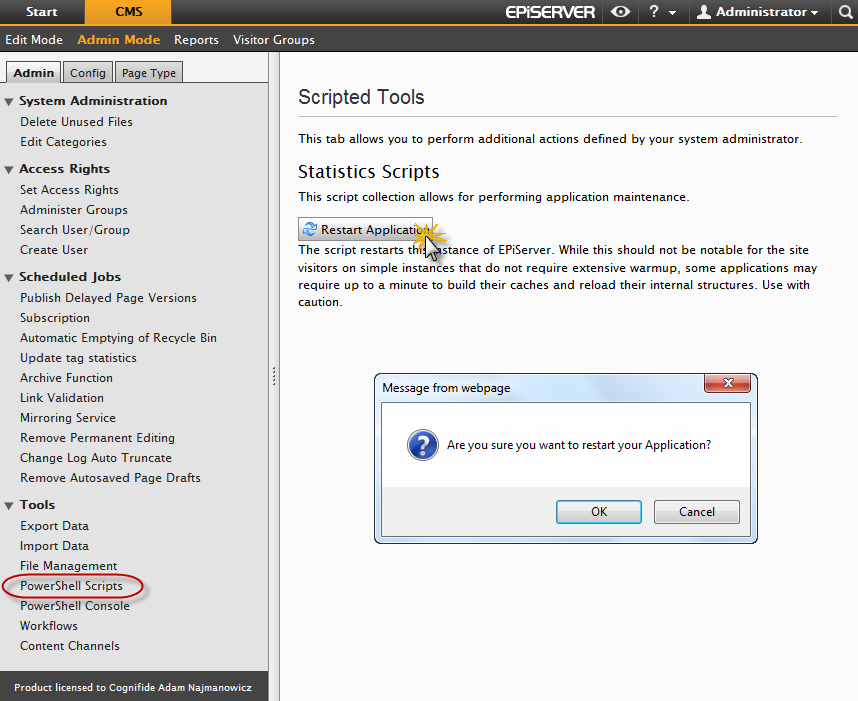
We had a situation in the company this week which required us to deliver the whole EPiServer virtual path provider file structure to the client – zipped. Easy enough? go to the EpiServer VPP directory and? well? ok? hmm? so the path provider is versioning and as a consequence the physical organization of files on the disk does not make any sense for a human trying to browse it.
Fine! So let’s create a native provider and do a copy and paste within the file manager?. hmm an exception complaining about the provider incompatibility?
Naturally, my knee-jerk reaction is – let’s do it with the PowerShell? which I recall was doing something like this in it’s previous version? The example I’ve tested and placed in the ?Samples? tab was:
Most of this post is also based on the Microsoft’s Windows PowerShell Quick Reference however despite the sharing scripting runtimes the nature of the both shells differ considerably as described in the previous post: PowerShell for EPiServer - cheat sheet - Part 1. In all cases where it made sense I’ve converted the samples to establish them in EPiServer scenarios.
How to Write Conditional Statements
To write an If statement use code similar to this:
Most of this is based on the Microsoft’s Windows PowerShell Quick Reference however despite the sharing scripting runtimes the nature of the both shells are pretty different (although the differences are not as vast as one might think).
Windows PowerShell
PowerShell Console for EPiServer
Interactive ? command can ask for confirmations and can be aborted. User can be solicited to provide input.
Batch ? all commands are being executed in one go, the script has no chance to ask questions, go or no-go decisions have to be solved within the script.
Supports colouring.
Supports plain text output only.
Supports command line arguments for running scripts.
All arguments are defined directly within the script or derived from context automatically.
Can access any file depending on the rights of the user.
Can only access files the web application identity can write to. Cannot access files on user?s machine but rather operates on the server?s file system. Cannot operate with elevated privileges.
That said, I considered that enough of the Reference document is irrelevant in the EPiServer scenario that it’s beneficial for the users of the console to have a bespoke cheat sheet created especially for the purpose of this plugin.
Ok, so I’ve got my shot of endorphins writing about PowerShell last week (damn, it’s nice to be able to code again!), and I got pretty determined on making it usable and achieving all the goals I’ve initially envisioned. and in the process build a usable tool and a library of scripts that people can use either directly or to modify to meet their needs.
It’s been a while since I had a chance to do any coding… turns out leading a development division tends to not have much to do with development… who knew?!
But I’ve finally got a moment to sit down and refresh the EPiServer PowerShell console and make it compatible with both CMS versions 5 & 6. You could technically use it before on CMS 6 but the looks of it was broken. (previous version available here)
I meant to write this a long time ago but somehow that never really got out of the room. Following is a narrative of an EPiServer site that was on and off the net for half a year or longer and what I’ve learned in the process.
We’ve gathered all the data from the client – we know they have implemented custom ?skins? (basically controls that brand the mini sites based on under which domain the site is being displayed. Quite a cool solution. Also since they were struggling with the speed they have implemented a custom mini taxonomy based on Lucene.net to speed things up. Yet the site is terribly slow and keeps showing the familiar (for a developer) ?Application is busy under initialization? from time to time.
This one definitely took more time than I initially expected, and before I devote even more to it I would very much like to hear your opinion. Do you find it useful? Which way should the development be going? But first things first?
Have you ever found yourself:
having to make a mundane change to a large number of pages?
in need of getting statistics on page properties or page type usages?
being curious of e.g. what’s the oldest page on your site?
having to copy or move a large number of files from one folder to another or between versioning and non versioning virtual path providers?
renaming or deleting files in your file store en-masse?
If the answer to any of those (and more) is a ?yes!?, I believe you might find my little plugin useful.
One of the many things we debate constantly at Cognifide is how to improve the user experience. How to make editor’s life easier, how to simplify the common everyday tasks, what can be automated, and simply how to make our customer smile a little when they use our projects.
For that to work, apart from the overall big blocks to be in place and working seamlessly (which is the absolute minimum required) – you need to be VERY attentive to details.
One of the most frequently and eagerly used programming constructs of the Microsoft.Net Framework is Enum. There are several interesting features that make it very compelling to use to for all kinds of dropdowns and checklists:
The bounds factor – proper use of Enum type guarantee that the selected value will fall within the constraints of the allowed value set.
The ability to treat Enums as flags (and compound them into flag sets) as well as a one-of selector.
The ease of use and potentially complete separation of the ?Enum value? from the underlying machine type representation that ensures the most efficient memory usage.
Surprisingly enough EPiServer as it stands right now does not have an easy facility to turn Enums into properties. To give credit where credit is due, the EPiServer framework provides a nice surrogate that mimic that behaviour to a degree. The relevant property types are:
Aparently I have written something on that note before for CMS 4 and it looks like someone still needs it as I got a request for an updated version for it a couple of days ago. So here we go:
for the most part the syntax for the call is equivalent to what is was before so go to my previous article regarding that (check out the old article for details). What I’ve added this time around is:
Last week or so ago a couple of friends in another project in Cognifide has run into a wall while trying to load test their website. the problem was as follows: The website is highly AJAX based – the page merely loads a stub in the initial request but then loads the rest of its data in a dynamic matter therefore a traditional web testing tools are fairly useless. What they tried was to setup a number of Selenium clients to pound the server, but that turned out to be fairly challenging to the machine doing the testing. It was not possible to set up more than 10 clients on a fairly strong machine.
Have you ever (or have your customers) created and edited a page in one language only to realize that their selected locale was wrong? Have you ever wished you could delete a master language branch of a page after creating its localized counterpart but you could only delete the newly created slave language instead? Have a customer ever requested that they could copy a whole branch and you convert it to another language so that they could then translate in-place?
Immediately after you implement the VirtualPathProvider proxy from my previous post you will notice a one fairly serious lack in it. Namely all the files within that provider will be hiding behind the registration form. That is not cool for a couple of reasons?
You may want to keep all of the files in one store – being forced to put them into a designated folder is not desired.
You may want to make some file freely available for some time and lock it after a while, or the other way around (e.g. to allow the robots to crawl it initially). having to move them is just silly and defeats the purpose.
So how do you discriminate the files that you want locked from those that you want to be publically available, and potentially from those that you want only the logged in users to be able to get?
With the culture of knowledge sharing and open source spreading, everyone races to show they have something valuable that you may want. And while you may not ask for money for your content you may still want to get something in return, say a contact, an email address that’s verified (or not), to keep in touch with the consumer of your content.
Yet a full fledged registration doesn’t seem like a proper thing to do – cluttering your EPiServer user repository with (let’s face it – for a large part fake or temporary email addresses that user create only to get your content).
Once you’ll update the framework to the extended one, you will immediately notice that… nothing has changed. Hmm… did something go wrong?
Well, not really. By default the framework will be run in the “legacy mode”. Thanks to an old article by our own Marek Blotny, I’ve learned how to build Plugin settings which are just perfect for the purpose!
So to configure and enable the new features you need to open your admin UI and in the “Config” click on the “Plugin Manager” item and select our framework plugin as shown in the picture
Back in the day when we started designing our last project we’ve been presented with a following problem – a big number of templates with slightly different sidebars.
Hmm…
Is sidebar a part of content? No, rather not. We don’t want the editors to have to setup the sidebar for every article they write (and the site has a few dozens of articles created on it every day).
Is sidebar more of a template thing? Well… more like it, but still… we have articles all over the site with different sidebar elements when the articles are in different parts of the site (ok so we could add rules what controls display in which part of the site). But wait! There’s more! The sidebar will be different for every language (region). Now we’re talking a dozen of templates or a rules engine just to make the sidebar different. Customising the template with properties isn’t ideal either as it makes EPiServer UI very cluttered. Additionally we want to change sidebars across many templates so the whole branch/section of the site will be able to share the same sidebar.
You’re editing your EPiServer 4 project and suddenly the edit mode stops working. the server reports compilation errors. something along the lines:
Compiler error: CS0433: Type ?EPiServer.Global? exists in ?c:\WINDOWS\assembly\GAC_MSIL\EPiServer\5.1.422.122__8fe83dea738b45b7\EPiServer.dll? and ?c:\WINDOWS\assembly\GAC\EPiServer\4.61.5.83__8fe83dea738b45b7\EPiServer.dll?
The solution is to go to your web.config and edit the compilation section. The section will most probably look something like this:
in my case only the 4th line referencing the EPiServer.dll was interfering with the editing working, but this can easily be trimmed to only first 3 options, so once you’re done with removing CMS5 entries it could look something like:
The configuration of the module is a descendant of any EPiServer Virtual Path Provider configuration. This aspect is fairly well described on EPiServer pages.
A sample configuration for the TextImageVirtualPathProvider can look as follows
physicalPath is where the cached version of images will be stored
shownInFileManager is “false” as there is nothing to present for the user in the file manager.
allowedReferrers is the regular expression containing the filter for sites that are allowed to access the path provider and get images. This has been added so that your server does not turn into the internet’s text-image open service :)
allowNullReferrer should be set to false in production environment but allows for testing by directly creating URL’s without using a page to fill in the referrer.
replacementStrings – this one actually turned out to be very useful since some characters are invalid and not even reaching the VPP if EPiServer or ASP detects them. so to allow for characters like colon or < or even a dot (which would make it hard to form regular expression if it was explicitly available) or * you need to create an escape token for them. The string is a coma separated list of token,value,token,value,…
virtualPath is something you need to change if you want your VPP to serve images under a different root level folder. (e.g. if you have a page with that name already)
Additionally for IIS6 (most common scenario) you need to add node to configuration for the VPP to work.
The module code is already available on Epicode SVN, the relevant wiki pages will be following as soon as documentation is complete.
The use case is as follows:
The client wants the site to look exactly as in a template provided as a image,
the text is using a non standard font that is not available on 60% of Windows machines,
the site does not use flash.
the site needs to be equally good looking in IE6 (more about it later)
The solution was to generate images, but how to do it the right way? This has presented us with a once-in-a-lifetime :) opportunity to create a virtual path provider, do something good and learn something new & cool in the process.
We’ve not been talking much about it and that’s partially my fault as well (busy with other projects), but Cognifide has a really cool initiative called Cognifide Labs that we intend to grow over time. The plan is to devote up to 10% company time into side projects that help us grow expertise and allow our devs to dwell into interesting technologies, methodologies and languages and develop their skills.
One of the first projects (that I took part in) is CogniScale - an app that allows FlexiScale users to manage their servers. Here’s the story…
I’m really glad to notice that Marek is getting into blogging about EPiServer. Marek is a really bright developer and a colleague at Cognifide with a number of successful EPiServer projects in his portfolio, we’ve worked together on Faceted Navigation (he’s the brain behind all the nifty editors in it) that I’m working on open sourcing of currently, and on the Setanta Sports Portal and the Setanta corporate site projects. Now he’s out in the wild writing about it. Go ahead and read his analysis on the performance of Episerver 4.x versus CMS 5. It appears that the CMS is getting… nah… I won’t spoil it for you… Read all about it on Marek’s brand new blog!
This article is a part of the series describing the faceted navigation system for EPiServer that we have developed in Cognifide and that’s already proven to be a robust solution for delivering tagged content a heavy traffic site. The engine will be released shortly as an open source project.
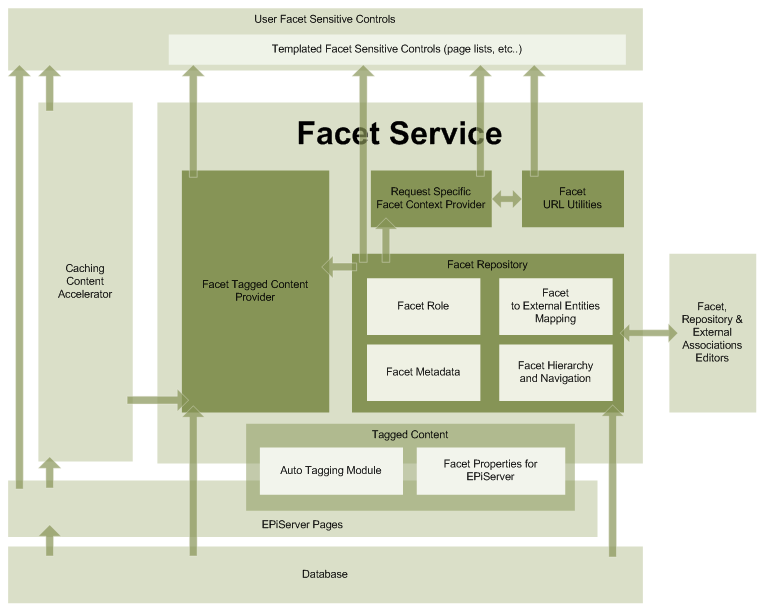
So how is the faceted engine structured?
Content provider
As you can see the driving force behind the engine is the Facet Tagged Content Provider. If you know EPiServer, the basic functionality of the module is roughly an an equivalent of find page with criteria for categories, which allows for searching pages tagged with facets with exclusion of some other facets and tagged some optional data, the module however is paging and and allows you to plug a feedback event handler so that your controls can accept or deny a story before they are sent to is and take part in the paging. The stories are provided to you in reverse order of publishing so you always get the latest stories first, (pretty much what any blog and any news site wants).
This article is the second of a series describing the faceted navigation system for EPiServer that we have internally developed in Cognifide, that’s already proven to be a robust solution for delivering tagged content a heavy traffic site, which will be released shortly as an open source project.
First of all we have to explain the nomenclature as it is going to be used quite a bit. A few terms we use pretty extensively are:
…with an unconventional approach to data fetching.
This article is a first of a series describing the faceted navigation system for EPiServer that we have internally developed in Cognifide and that’s already proven to be a robust solution for delivering tagged content a heavy traffic site, which will be released shortly as an open source project. The article outlines some pitfalls of EPiServer that we’ve run into and the nature of the project in which the module was used first and which influenced a lot of our design decisions.
This is a slightly dated post (written around November last year), that I forgot to post some time ago, so bare in mind, we’ve already started working on the faceted navigation getting open source status and I’ve updated the first sentece to include Adam Matusiak joining our team - Welcome Adam!
Over the last month or two our hive mind has assimilated two new voices, our thoughts have become one with Greg’s, and Adam’s.
Just a daily time saver, for reuse at another time.
Any old time windows developer, will remember the fun of using the ini files with GetPrivateProfileString. As much as ini files sucked there is one nice aspect of that call - you can setup a default value it is to return in case a value is not specified in the file. Similarly in a daily episerver programming you usually want to read a value but if one is not epcified you will usually want to use another value and just move along with the progress, and not really care to have an if there to do the filling in. Not to limit the property to any specific type - the task can be nicely solved with generics to handle pretty much any type of property.
As much as I seem to be enjoying my trip with EpiServer there are some little things I don’t seem to appreciate all that much and I’m not quite sure how to work around some of them in an elegant way.
EpiServer has a fairly advanced way of dealing with properties but it also seems to be a bit tough on the developer whenever you try to do something more than just strictly using its API-s. One of the areas I don’t really enjoy is the dealing with the pages that are expired or generally unavailable for the user for various reasons.
As we’ve been debating with Steve in the EpiCode IRC channel (Come on, join us there! You know you want it!) a few days ago, probably one of the biggest missing features in EPiServer is multi-page property.
adding a great number of consecutive pages is a tedious process
it’s not native to EPiServer, meaning - if I use it in my module that I would like to distribute later I need to put the control there. Short of potential licensing issues, this introduces an unnecessary complication level for such distributable modules
Another big issue with the page selecting dialog - apart form being unable to select multiple pages is its inability to root it anywhere outside the original EPiServer repository root. This really limits its quality in terms of re-using of its functionality to be able to use it for selecting of a limited set of pages.
Searches paged in the database have posed a problem in SQL Server at least prior to version 2005. I’ve found some solution to the problem on the net but they were so cludgy that I would never really put anything like that in a production server. I hope the following will shed some light on how they work in general by using in in EPiServer context.
Theoretically in EPiServer you can pull the pages that match the criteria from the database with EPiServer.Global.EPDataFactory.FindPagesWithCriteria() into the PageList but that seemed to be imposing a strong performance penalty with increased number of pages meeting the criteria. Since this search is sometimes done even multiple times on a page request in our project we needed something better.
Our friends at EPiServer AB has just let us know that they are in need of EPiServer CMS specialists that might be looking forward to working with them directly, so if you’re an EPiServer professional and meet the requirements specified on the recruitment page give them a shout!
If you’re not already familiar with EPiServer you’re probably not going to make it this round, but then again I suggest you start looking at it now. EPiServer AB is a really dynamic company recently expanding aggresively on the international markets - and rightly so. EPiServer is deserving every credit it can get. I can say that my journey with it so far has been really smooth and I’ve enjoyed every bit of it. So if you’re not up to it, get ready for the next round, in the mean time, grab yourself a login - download a copy of the documentation from the Knowledge Center, a demo license and join us on the Developer Forum.
It’s a great bunch, really fun to work with.
I’ve discovered yesterday on Steve’s blog that him and our other friends on EpiCode have gathered on IRC (something I’ve been lobbying here at our company for quite a while). Come, drop by, let’s meet!
I’ll definitely try to hang out there as much as I can. great to meet you guys.
As Steve suggests - grab yourself a copy of XChat or aMirc, connect to irc.freenode.net and /join #epicode
What a great idea!
Since my effort towards making this control final has been somewhat limited lately, I’ve decided to simply release the code at its current stage so that others can play with it and perhaps we can have something decent done together. The control operation is described in my previous article therefore I will not be going much into it any longer. the deployment of it is something worth mention though…
Download the control form here. Extract the contents of the zip file to a folder and attach the project to your solution, make sure you have the proper EPiServer libraries referenced form the project or it may complain about the references being broken.
To finalize my mini series on the object store I’d like to put a simple page comments library. The library takes care of everything that is required for you to post and retrieve a list of comments. It does not (so far) offer any moderation functionality or even facilitates any comments removal. It’s something that I will most probably be added in the process.
I am in the process of figuring out how I can contribute it through the Community EpiCode effort on CodeResort. As soon as I get some answers from Steve, I’ll get it uploaded there. In the mean time let me document how to start using it.
I think we’re mostly finished investigating ObjectStore for now. In this article I’ll try to finish up on the apsects of using the Object store in a real life solution that is a basic Page comments. In my previous article concerning ObjectStore I have described a way of storing and retrieving an object from the Store, which is fine and dandy if we know exactly the object’s OD, for example if we reference it from a page. But what good is a store like that if we cannot search it for content? The problem we were trying to solve using ObjectStore was storing comments for ANY Episerver page without having to do anything to the page type. We might need that for the upcoming project so the discovery may prove useful since this is a really neat way of storing objects.
EPiServer developer-to-developer forum holds an article on how to make EPiServer 4.61 run on Vista. I suspect that EPiServer CMS (a.k.a. EPiServer 5) will not have any of the described problems, but in the mean time I’m happily hacking my EPiServer on my other machine as well.
I’ve managed most of the way before and had the server running here, but it was having all sorts of problems, which are all gone after applying the suggestions (especially in the second post).
We’ve been looking at the way to efficiently store a lis of quotes some time ago. And Steve suggested that if we’re to store a gian number of quotes, we may look into some misterious being called ObjectStore…
If there will be many qoutes, e.g. you buy a “100.000 quotes of the day” database, you might want to put them into a separate table in the database. Seasoned EPiServer developers tend to think that everything can be stored as pages in EPiServer, which is kind of true, but not necessarily wise.
Another option could be to store the quotes in the ObjectStore, the general EPiServer storage feature, which can hold about anything you’d like, efficiently, quickly restorable, searchable, indexable, highly available and environmentally safe. It might even solve the global warming problem while we’re at it. Ok, maybe not. Truthfully, only a few developers outside of EPiServer know how to use it, and quite alot of us inside have no clue whatsoever. But, the tales I’ve heard about it would nominate it as a prime candidate for a quote system like this. Right now, it is storing things like XForms definitions and data, WSRP stuff, Content Mirroring data and lots more. It’s been around since 4.50 (I think) and is said to be documented - eventually, until then I guess we’ll have to resort to other ways of doing things.
Since IIS on XP seems to be handling only one site at a time and I have multiple installations of EpiServer for different purposes on my machine I needed a fast way of switching between them.
Sure I could go to the administration console and do it manually, but hey, why waste 30 seconds every time you do it when you can actually batch waste them in a chunk of half an hour to automate it.
so here’s my findings.
The adsutil.vbs is the script you want to get intalled on your system somewhere in the search path. %systemroot% will do.
You will find the script on your XP CD in the \i386 folder. Unpack with the following command:
I’ve recently had a chance to write a Google Maps control for EPiServer, it’s still somewhat buggy and I’m still considering how to release it since it still contains some java script that is potentially GPL infected and I would not like to contaminate someone’s code with it. I may end up rewriting it to some extent or make it more server side so that it’s completely ASP based.
Anyway…
We’ve started working on the rewrite of our site internally in a few CMS’es basically creating an internal competition on which of the engines/teams can do the best the easiest and the fastest site. I can say honestly, EPiServer has been a blast! Virtually any control we’ve decided to place there was almost completely effortless. The controls that are delivered (with sample usage on the demo site) just seem to cover everything. Well, almost everything. There is no map creation component as far as I can tell.
I’ve been wanting to write this control for quite a while and since I deployed a wiki for my family and started filling it in. I had a really nice experience with this Google Map extension to the MediaWiki. I wanted us to have the same on our site. And in the mean time we’ve started running into some limitations that required us to write some plugins for the editor’s site of the CMS. Striking two birds with one stone, here comes the Google Maps for EpiServer.
Anyone familiar with EpiServer knows that the CMS allows you to define the content on any given page through a set of properties defined for its page type. There is a handful of those, and each of them comes with a specific editor. Some of them even come with so called DOPE (Dynamic-on-page-editing). This feature is really so cool that by itself it’s probably one of the driving selling factor. I wanted it all!
To deliver it you need to inherit a property, (in my case I decided to go with a LongString as I can easily go over the 255 char limit if the user woudl decide to have more than a couple of flagpoints on his/her map) and define its editors.
I’ve found out that the property can be easily integrated with the CMS (virtually without any user intervention) by means of attributes/reflection. So here we go:
The challenge - The site that we will be coding will have its pages tagged with episerver categories. Implement a control that will list all the pages tagged with a specific category.
The control aspx code seems looks pretty straightforward and is derivative of some other controls that are defined in the EPiServer sample site:
The wirst thing you will notice after looking at the code is that PageList is pretty much a standard ASP.NET reinvented and rehashed. GREAT! Sounds like we can use the Data binding, right? That’s also true:
EPiServer is an Interesting technology we’ve started working on recently. I will try to blog my impressions and the progress over the course of learning the solution.
Since I just seem unable to learn by reading docs I chose to build an email obfuscating (antispam) control and a paged search as an exercise and a way to learn the guts of the EPiServer.
A couple of loose thoughts for a start…
Translation
I am not sure I fully appreciate the way the translation is performed for the parts of the system that is editor independent . The translation is done by means of xml files stored on the disk in the /lang folder.
Basically what that means is that it’s much more prone to missing translations and thus is not as translation friendly as it could fairly easily be.
For the content I can always fall back to the e.g. english version and look what’s the original value there. not so much for the framework translations. Is there a tool for that? I will investigate that later as we’ll probably want to create a number of controls for the website we’ll be working on soon, and that will need to be translated to many languages. And not just that but also the original template files - we will need much more than what’s available originally in EPiServer.
So once you define your control’s content: